 |
|
|
At the inception of WoA, number of other aircraft purchase-options were initially considered, including types with side-by-side seating and lower cockpit-sides, which would possibly have made wheelchair-access easier. However, we chose instead to buy the established product- a decision which has since been proven correct in terms of the solid, reliable service this aircraft has since given.
One other deciding factor was that Schleicher are able to provide a
factory conversion for the K21, allowing hand-control of the machine
from both seats. Being already tested and certified to German standards,
this conversion saved us a lot of time and effort in making WA1 ready for
wheelchair-users.
The K21 is a two-seat glider (or sailplane), constructed of glassfibre. Although notionally classed as a pilot-training aircraft, its performance compares very favourably with many single-seat gliders. Despite being docile in handling and relatively easy-to-fly, it is also capable of extended cross-country flights, high-altitude soaring, and most types of aerobatic manoeuvre.
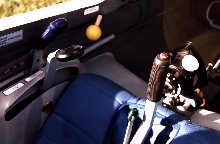 The
controls of a glider operate in almost the same manner as a small powerplane;
a contol-column or joystick being the main flight-control, and operating
ailerons for roll (turning) and an elevator for speed-control. Conventionally,
two-foot-pedals operate a rudder. The rudder is needed to "balance" the
turn, and to steer the aircraft on the ground. It is this need for foot-control
of the rudder which the design of WA1 eliminates, by substituting an extra
hand-lever for the pedals. Click the cockpit-view for more infromation
on the controls.
The
controls of a glider operate in almost the same manner as a small powerplane;
a contol-column or joystick being the main flight-control, and operating
ailerons for roll (turning) and an elevator for speed-control. Conventionally,
two-foot-pedals operate a rudder. The rudder is needed to "balance" the
turn, and to steer the aircraft on the ground. It is this need for foot-control
of the rudder which the design of WA1 eliminates, by substituting an extra
hand-lever for the pedals. Click the cockpit-view for more infromation
on the controls.
As in most two-seat gliders, the pilot-under-training sits in front, and the instructor at the rear. This seating-arrangement is preferred to the side-by-side arrangement found in small power aircraft, as in gliders it is necessary to keep the fuselage of the aircraft as slim as possible, to maximise performance. A wingspan of 18 metres gives the K21 a good soaring performance.
One of the key advantages of a glider for this kind of flight-training is the almost-complete freedom from noise and vibration. At typical flying-speeds of 45-70kts, normal conversation is possible in the cockpit without the use of headsets. Addtionally, maintenance costs are considerably lower than for a powered aircraft, the engine being the highest-maintenance item of equipment in any small plane.
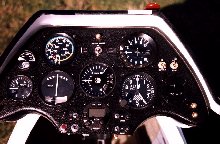 The
instrument-panel of WA1 is, again, not all that different from any other
light aircraft, perhaps one of the key factors being that the instruments
must operate from onboard batteries, there being no engine or generator.
In practice two batteries are normally fitted, so as to provide a reserve-backup.
These batteries are of the "gel cell" rechargeable kind, and live within
the empty space inside one of the wings. WA1 is fitted with sufficient
instrumentation for cross-country flight capability, a 760channel radio
capable of commincating with Air Traffic Control as required, and a precision
electronic soaring instrument, the "vario" - which acts as a sensitive
detector of rising air.
The
instrument-panel of WA1 is, again, not all that different from any other
light aircraft, perhaps one of the key factors being that the instruments
must operate from onboard batteries, there being no engine or generator.
In practice two batteries are normally fitted, so as to provide a reserve-backup.
These batteries are of the "gel cell" rechargeable kind, and live within
the empty space inside one of the wings. WA1 is fitted with sufficient
instrumentation for cross-country flight capability, a 760channel radio
capable of commincating with Air Traffic Control as required, and a precision
electronic soaring instrument, the "vario" - which acts as a sensitive
detector of rising air.
Oxygen equipment is also fitted. This is not required for routine training-missions, however its presence does extend the high-altitude capability (of the pilots, not the aircraft!) from around 10000ft to 25000ft or more. This additional height-capabilty proves very useful in wave conditions, where the best lift is often found at quite high altitudes. In order to benefit from oxygen, pilots must wear a face-mask or cannula. This provides an oxygen-enriched supply of breathing air to the pilot, in order to compensate for the low pressure at these altitudes. (Without onboard oxygen, a pilot's ability to concentrate, and to operate the aircraft safely, diminish rapidly above 12000ft or so, due to the brain being starved of oxygen.)
A possible downside to the use of a glider is the greater need for groundcrew. Whilst a powerplane can in principle be operated by a single person, a glider does need help with getting airborne, typically in the form of a towplane or winch driver, plus two or three ground-handlers. (having no engine the glider is unable to taxi, and so must be towed to the runway for launch, and recovered by tow-vehicle on landing.) Thus WoA is bound to be a people-intensive operation, a fact which makes us grateful to those who lend their muscle-power!
WA1 normally lives in the Portmoak main hangar. There's also a fully-equipped road trailer to allow for field-landing recovery or expeditions to other soaring sites. As with most gliders, the wings and tailplane are detachable to allow road-transport.
Whilst a number of other aircraft, power and glider, have been
modified for hands-only control, as far as we know WA1 is the only aircraft
in the UK to have full 2-seat hand controls. With dual hand-controls, instruction
can be given by a person using the same control configuration as the pilot-under-training,
or either seat can be reconfigured for conventional hand/foot control as
required. This also opens the possibility for a hands-only pilot to become
a fully-qualified instructor, able to train able-bodied pilots in the art
of flying. This is something which we would very much like to see happen
in the near future, as more wheelchair-users gain flying experience in
this aircraft.